Link To TurkPrime

How to run successful experiments and get the most out of Amazon's Mechanical Turk

Showing posts with label turkprime. Show all posts

Friday, August 10, 2018

Concerns about Bots on Mechanical Turk: Problems and Solutions


Data quality on online platforms
When researchers collect data online, it’s natural to be concerned about data quality. Participants aren’t in the lab, so researchers can’t see who is taking their survey, what those participants are doing while answering questions, or whether participants are who they say they are. Not knowing is unsettling.

Recently, the research community has been consumed with concern that workers on Amazon’s Mechanical Turk (MTurk) are cheating requesters by faking their location or using “bots” to submit surveys. These concerns originated and have been driven by reports from researchers that there are more nonsensical and low-quality responses in recent studies conducted on MTurk. In these studies, researchers have noticed that several low-quality responses are pinned to the same geolocation. In this blog, we’d like to add some context to the conversation, share the findings from our internal inquiry, and inform researchers what TurkPrime is doing to address the issue.

Concern about Bots
The recent concern about bots appears to have begun on Tuesday, August 7th, 2018, when a researcher asked the PscyhMap Facebook group if anyone had experienced an increase in low quality data. In just the third response to that thread, another researcher suggested, “maybe a machine?” Soon, other researchers were reporting an increase in nonsense responses and low-quality data, although at least a few reported no increase in junk responses to their studies. The primary piece of evidence causing researchers to suspect bots was that most of the low-quality responses were tagged to the same geolocation and a few places in particular—Niagara Square in Buffalo, NY; a lake in Kansas; and a forest in Venezuela. What’s more, many respondents from these geolocations provided suspicious responses to open-ended questions, often answering with “GOOD STUDY,” or “NICE.”

Although this activity raises concerns, the conversation, so far, has overlooked some important points. Most critically, while it is clear some researchers have unfortunately collected several bad responses, the research community does not yet know how widespread this problem is. Diagnosing the issue requires knowing how many studies don’t fit the pattern, as well as how many do.

Scope of problem
At TurkPrime, we track the geolocation of all surveys submitted in studies run on our platform. In the last 24 hours, we have worked to determine whether there is a growing problem of multiple submissions from the same geolocation. In reviewing over 100,000 studies that have been launched on TurkPrime, we see that the rate of submissions from duplicate geolocations typically bounced from less than 1% to 2.5% within a study—a number that could be explained by people submitting surveys from the same building, office, internet service provider, or even the same city. Geolocations are not precise, an issue we will discuss in more detail in a future blog post.

Based on this analysis, we set 2.5% as the threshold for detecting suspicious activity. Over 97% of studies have not reached this threshold, showing that the overwhelming majority of studies have not been affected by data coming from  the same geolocation. 

However, when we look at the rate of duplicate submissions based on geolocation over time, we see that in March of this year the percentage of duplicate submissions began edging up. Clearly, this is a problem, but a problem that has emerged only recently.

What TurkPrime is Doing
At TurkPrime, we are developing tools that will help researchers combat suspicious activity. We have identified that all suspicious activity is coming from a relatively small number of sources. We have additionally confirmed that blocking those sources completely eliminates the problem. In fact, once the suspicious locations were removed, we saw that the number of duplicate submissions had actually dropped over the summer to a rate of just 1.7% in July 2018.

What you can do to eliminate the problem
In the coming days, we will launch a Free feature that allows researchers to block suspicious geolocations. This means researchers will be able to block workers from suspicious geolocations, excluding submissions from those locations in their data collection. We will also launch a Pro feature that allows researchers to block multiple submissions from the same geolocation within a study. This feature will cast a wider net and may block well-intentioned workers using the same internet service provider, or working in the same library. This tool will give researchers greater confidence that they are not receiving submissions from anyone using the same location to submit junk responses.

Conclusions
Our data, and the work of multiple researchers, show there has been a recent increase in the number of low quality responses submitted on Mechanical Turk. Data from the TurkPrime database show that the vast majority of all studies, and the vast majority of recent studies, have never been affected by the current concern of bots. What we still don’t know about the recent issue, is whether these responses are coming from bots or foreign workers using a VPN to disguise their location and submit surveys intended to sample US workers. Either way, in the coming days TurkPrime will release tools that allow researchers to block workers from suspicious locations and to decide how narrowly they would like to set the exclusion criteria. Concerns about bots and low quality data on MTurk are not new. But at TurkPrime we will continue to look for ways to ensure quality data and to make conducting online research easier for researchers.     

Sunday, December 24, 2017

We are Hiring: Project manager/research assistant position (full time)

TurkPrime
Queens, NY
Project Manager/Research Assistant


Background: TurkPrime is a web-based platform for online participant recruitment for the social and behavioral sciences, market research, and medical research. TurkPrime was launched in May, 2015, and currently serves over 6,000 subscribers from universities and corporate institutions around the world. Over 3,000  studies are conducted on TurkPrime each month.


The TurkPrime Toolkit is a set of cutting edge research tools allowing for flexible online study management and data collection using multiple platforms including Mechanical Turk. TurkPrime manages a panel of over 150,000 Mechanical Turk respondents, and partners with multiple additional sample providers through API integration to achieve a global reach of over 20 million respondents. The combination of robust research tools as well as an extensively profiled participant pool allows TurkPrime clients to conduct high quality research flexibly and effectively.


TurkPrime is also actively engaged in academic research focusing on, but not limited to,  online data collection methodology1-5. The research team at TurkPrime works closely with our software development team to make sure that TurkPrime’s system and research practices are grounded in solid empirical research, and that the features we provide are beneficial to a wide range of researchers. TurkPrime’s research team has a track record of peer-reviewed publications that address issues such as the contribution of its software to research design and data quality, assessment and improvement of data quality on Mechanical Turk, and selective recruitment from Mechanical Turk and other platforms.


We are looking for a full time project manager/research assistant with extremely strong communication, organizational and writing skills to manage projects, help clients with technical questions, collect data for online projects, and help write peer-reviewed papers, white papers, and blog entries.  


Responsibilities: The key responsibilities for the position include: client management including responding to TurkPrime users’ questions, managing complex client projects (e.g. intensive longitudinal, diary, dyadic, and video interview studies), writing a weekly blog, study design and data collection, supporting the writing of peer-reviewed and white papers, maintaining project documentation, managing project data and materials, and quality control.


Skills: Extremely high writing and communication skills; Exceptional organization and attention to detail; Ability to use web communication and documentation software effectively; Team-oriented; Very strong work ethic; Multi-tasking; Self-starter and industrious; Adaptivity to rapidly changing demands in a high performance workplace; Background in scientific methodology (B.A. or more is required for the position).  Experience with conducting online research and knowledge of online research software (Qualtrics, Millisecond, MTurk etc) is a plus. Data analysis skills are a plus. Interest in publishing peer-reviewed papers is a plus.


Notes: TurkPrime is based in Kew Gardens Hills, NY. Initially, the project manager would be expected to be in the Kew Gardens Hills office 4 days per week. Over time, a more flexible schedule will be considered. TurkPrime is an equal opportunity employer and strongly encourages applications from members of groups underrepresented in science and technology industries.  


Applying: Please send a resume and a letter of interest to leib.litman@turkprime.com.   


Representative Recent Publications
1.   Litman, L., Robinson, J. Online Research on Mechanical Turk and Other Platforms. Sage Publications. Innovations in Methodology Series (367 pages). Scheduled to be published in 2018.
2.   Litman, L., Robinson, J., & Rosenzweig, C. (2015). The relationship between motivation, monetary compensation, and data quality among US and India-based workers on Mechanical Turk. Behavior Research Methods, 47(2), 519-528.
3.   Litman, L., Robinson, J., & Abberbock, T. (2016). TurkPrime. com: A versatile crowdsourcing data acquisition platform for the behavioral sciences. Behavior Research Methods, 1-10.
4.   Litman, L., Williams, M. T., Rosen, Z., Weinberger-Litman, S. L., & Robinson, J. (2017). Racial Disparities in Cleanliness Attitudes Mediate Consumer Attitudes toward Cleaning Products: A Serial Mediation Model. Journal of Racial and Ethnic Health Disparities, 1-9. (Developed methods relating to selective recruitment on Mechanical Turk).
5.   Litman, L., Robinson, J., Weinberger-Litman, S. L., & Finkelstein, R. (2017). Both Intrinsic and Extrinsic Religious Orientation are Positively Associated with Attitudes Toward Cleanliness: Exploring Multiple Routes from Godliness to Cleanliness. Journal of Religion and Health, 1-12. (Developed methods relating to selective recruitment on Mechanical Turk).

Friday, December 15, 2017

New Feature: Exclude Highly Active Workers

Some workers on MTurk are extremely active, and take the majority of posted HITs. This can lead to many issues, some of which are outlined in our previous post. Although MTurk has over 100,000 workers who take surveys each year, and around 25,000 who take surveys each month, you are much more likely to recruit highly active workers who take a majority of HITs. About 1,000 workers (1% of workers) take 21% of the HITs. About 10,000 workers (10% of workers) take 74% of all HITs.

TurkPrime now has a feature to allow researchers to exclude the most active workers so that you can collect data from less experienced workers who are less likely to have previously taken part in research similar to your own. Below is a screenshot of the “Naivete (Exclude most active Workers)” feature. You can select what percentage of workers you would like to exclude from the dropdown menu seen below. 

Friday, December 8, 2017

TurkPrime Optimization

TurkPrime has been Optimized for Speed and Performance

Over the past few weeks, we have applied significant resources to improving the user experience for the research community and Turk and Prime Panel workers who use our site. Many of the operations and web pages now have increased speed and security so that creating, editing and launching studies are more than 10 times faster than they were previously. In addition, the dashboard where researchers can view their studies has been optimized and now loads and updates very quickly.

We are continuing to improve responsiveness in the system and customer support. Even more exciting, we are rolling out new features which will further create a more enhanced researcher and worker experience.

As always, our development is guided by our users in the research and worker communities; we at TurkPrime value your feedback and would love to hear from you how we can improve our services, which features you need and anything else that we can be of service to you via our Suggestion Box. 

Thanks for using TurkPrime!

Friday, November 17, 2017

Upcoming New Content on the Blog

Greetings Reader,


We would like to inform you of upcoming new content to the blog! We have been posting sporadically, but plan to have weekly content for you in the future. Posts will cover a host of topics relating to conducting research online. We will aim to provide content that can be useful to both novice and more experienced readers. Content will explain features of MTurk and TurkPrime, as well as Prime Panels, that people may want to better understand. Posts may also often have suggestions for best practices based on our knowledge of how to get the most out of online research on MTurk and beyond. We will also discuss hot topic issues as they arise, and are additionally happy to take some requests from readers for future posts as well.

The TurkPrime Team hopes that you will find these blogs informative. We are committed to providing information to our users that can enhance their use of TurkPrime, and their knowledge of issues in online research.

Friday, December 2, 2016

Verified US Region Targeting

Verified US State and Region Targeting

Problem: Many researchers wish to target participants from specific states or US regions of the United States like from the Northeast or the West. The issue that they often encounter is that using the MTurk Geographic Qualification specifying the US state is often not adequate to ensure that the participants reside in the specified state. 

The MTurk state may be incorrect since workers move since setting up their MTurk account and it has been reported that MTurk uses the worker bank location as the worker's state which may have never been the state of the worker's residency. TurkPrime internal quality tests have shown that up to 25% of the worker reported states using the  MTurk Geographic Qualification are inconsistent with the worker's state as reported by their IP address.

Solution: The TurkPrime Pro feature to verify location by Ip address and the US Region selector will only qualify workers whose IP address has been verified as being located in the study's required state or US region. All other workers will be disqualified from taking the study.

In addition, to run regionally targeted studies, TurkPrime now includes a region selector which automatically includes IP state verification to endure quality results.


Dynamic Secret Completion Codes for SurveyMonkey

TurkPrime Supports Dynamic Completion Code for SurveyMonkey

Users of Qualtrics and Google Forms have long enjoyed the ability to integrate dynamic secret codes for each participant in their TurkPrime study. Dynamic codes ensure that each MTurk worker participating in your study receives a unique code completely eliminating the possibility that workers share secret codes.  In addition, with auto-approval enabled, those workers are automatically approved without any need for researchers to manually check the worker supplied secret codes and approve workers.

Now, TurkPrime users who host their studies on SurveyMonkey can also use dynamic completion codes as follows:
  1. Check off "Dynamic Completion Code For Qualtrics" when you design your TurkPrime study
  2. Redirect participants at the end of your SurveyMonkey study to https://www.turkprime.com/Router/DynamicCode

Friday, September 9, 2016

How to Create a Universal Exclude Worker List

Problem: 

Requesters may observe that some workers, even those with high Approval ratings, may not perform to their expectations on a study. Sometimes this may result in rejecting their work which affects the Worker approval rating. But, often the work is not acceptable for research but is not worthy of rejection, or, it may simply be the policy of the research lab to approve all assignments for IRB or some ethical standard they may follow. 

At this point the researcher may wish to exclude these workers from all future studies. MTurk has an option to Block a Worker (available through the API) but our experience has been that this solution is somewhat draconian and extreme: the effect of a Worker Block can trigger the suspension of the Worker's MTurk account. 

(Source: When I was a newbie Requester in 2012 I blocked some workers who gave me inconsistent and poor responses . I learned the hard way by having my Turkopticon rating suffer and the MTurk Worker discussion groups spread the bad word. I responded to the Worker complaints and Unblocked them to undo the damage to their reputation -- and mine!)

Solution:

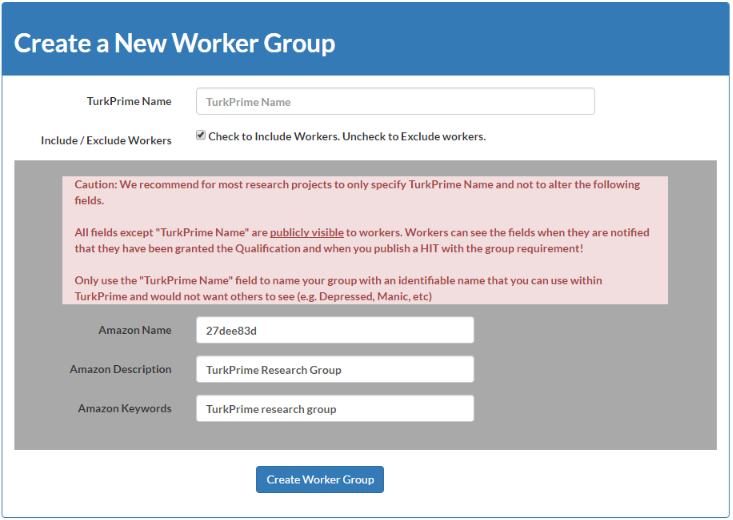
Create a Universal Exclude List using the TurkPrime Worker Group feature. This exclude list simply excludes all specified workers in this group from taking a study with this Group Requirement. When you design your studies, just add this exclude group to your Worker Requirements and none of the workers in this exclude group will be qualified to take your study. 

This will achieve your goal of blocking undesired Workers without tarnishing their reputation.


Reusable Include and Exclude Groups

Problem: You are running a longitudinal study and have identified 1000 workers who you want to allow to take your second phase studies. How do you easily group those workers for easy access. 

Or you want to exclude certain workers from taking a number of your studies and wish to group them for easy exclusion in future studies. How can you do that?

Solution: Use the TurkPrime Worker Groups feature available in the Manage Workers menu. This allows you to create reusable worker groups for either inclusion or inclusion in studies. You simply select whether this group is an include or exclude group, give it a clear name and specify the workers in the group. 

Workers will not know why they were targeted for inclusion or exclusion since the MTurk Qualification name used is a random sequence of characters. The TurkPrime Group Name will not be visible to Workers. This is important so that you can run blind studies (i.e. the workers who are specified for inclusion will know they were targeted because they are exhibiting a certain personality, for example)

When you design your study, and specify Worker requirements, add this group to the worker requirements and all workers in that group will be wither included or excluded, as needed.

Thursday, September 8, 2016

MTurk Panels on Your Own Requester Account

Studies with Panels  for just $0.15 - 0.75 / complete

Now you can run Mechanical Turk studies using your own Requester account and specify over two dozen demographic traits!.  The traits include gender, ethnicity, age, marital status and sexual orientation. But it does not stop there! The available options also include occupation, medical and health history, cell phone use and much more.


The cost ranges from $0.15 - $0.75 per completed assignment. For example, if you run a study with a panel of 100 White Males 40 and under with a cost of $0.42 / complete the TurkPrime Panel Fee is 0.42 * 100 = $42.00. The panel fee is determined by the incidence rate of your particular panel so that harder to reach demographics cost more...but are capped at a maximum of $0.75 per complete.

In addition, TurkPrime displays the feasibility of the study to run to completion. This is not a guarantee that the workers will take your study. since the MTurk workers, ultimately, decide whether they will accept and complete your study based on many factors including worker payment, requester rating on TurkOpticon and clarity of your study, among others. 

If you want to be certain your study will run to completion we recommend using the TurkPrime Lab Services of either Prime Panels or MTurk Panels where TurkPrime manages all user interaction, reaches out to workers to complete your study and guarantees the study will run to completion.

Studies with MTurk Panels will display the panel traits in the study dashboard along with a tag marking it as a panel study, as shown below.


Tuesday, July 26, 2016

Google Forms Integration with TurkPrime

Google Forms can be used to deliver a study with TurkPrime in a similar manner to other survey platforms (like Qualtrics and SurveyMonkey).

In Google Forms set up your survey and then set up the secret completion code display:
1. Click on Settings (the gear icon)
2. Click on Presentation
2. Change the confirmation message to include "Your secret completion code is ABCDEF". (Of course, replace ABCDEF with your own code)

Then get the Google Form link 
1. Click on SEND
2. Click on the Chain / Link Icon
3. Click Copy (or just copy the URL)

On TurkPrime you can then select your panel if desired, add the  Google Forms survey  link URL and in the Tab (How workers are paid) enter the fixed secret completion code.  (e.g. ABCDEF)  

Friday, February 19, 2016

New Safety Feature: Assignment Rejections are not Automated and Require Manual User Action

Many researchers set up their studies to use the TurkPrime AutoApprove feature so that they do not need to manually approve worker assignments based on the secret code that workers enter. On occasion, a researcher may set up his study incorrectly which results in many worker assignments getting automatically rejected. This was a significant cause for distress among the Mechanical Turk workers who received rejections for their work which then went unpaid and also lowered their MTurk approval rating.  This was also a sore point for TurkPrime researchers who had to deal with upset workers and correspond with them, and often reverse their rejections

To alleviate this issue, TurkPrime will give researchers greater control of the rejection process when AutoApprove is used: 

Only worker assignments that have the correct secret codes will be auto-approved while workers with invalid secret codes will require manual rejection. (If a rejection is made in error by a researcher, it may still be reversed.) This manual rejection is made using the same interface as is available for non-AutoApproved workers as shown below.

Researchers will see the secret codes the workers entered and whether they were correct. they will then have the option to approve, reject or leave their status undecided.

The manual rejection process must be completed within the Amazon Approval window (default of 7 days). Otherwise, Mechanical Turk will automatically approve the pending assignments that were not resolved buy that time.

Monday, January 18, 2016

Anonymize Mechanical Turk Worker IDs

We recently launched a ground-breaking feature that helps protect Mechanical Turk worker identities. It has been reported in the literature that Mechanical Turk Worker IDs can be used to identify the worker. This is because Amazon uses the same value for both the Worker ID on Mechanical Turk and elsewhere on Amazon properties like Amazon.com product reviews.

The Anonymize Worker IDs feature anonymizes Mechanical Turk Worker IDs, as discussed below.
When you enable the Anonymize Worker IDs feature, all Worker IDs that appear in your study's downloadable CSV file will appear encrypted. For example, if the Worker ID is "ABCDEFGHJKL", it will instead appear as "TP_1UPKSI2WHSJ4". This encrypted TurkPrime Worker ID begins with letters TP and can be used in all operations on TurkPrime where an Amazon Worker ID can be used:
  • Exclude and Include Feature supports both Amazon Worker IDs and the encrypted TurkPrime Worker IDs.
  • Reusable Worker Groups can specify both Amazon Worker IDs and the encrypted TurkPrime Worker IDs.
  • Bonus Workers can specify both Amazon Worker IDs and the encrypted TurkPrime Worker IDs.


Tuesday, January 5, 2016

HyperBatch - Run Batched HITs at Hyper Speeds

HyperBatch Feature 

You can now run your Amazon Mechanical Turk studies at Hyper speeds. We worked hard to make the experience identical to our classic MicroBatch option so that you simply launch your study and TurkPrime does all the heavy lifting for you.

How it works

When you launch a HyperBatch study with 100 participants, for example, your study appears on TurkPrime exactly as a standard study. However, the study, in fact, is broken down into multiple HITs with 9 or less participants. When you pause or change a study, all of the HITs associated with your study are paused or updated, respectively.

Workers who completed one HIT in the study are disabled from taking additional HITs. TurkPrime automatically assigns the Worker a Qualification that prevents them from taking your study twice.

All existing features such as secret code, include / exclude / groups etc work exactly as you expect them to.

Tuesday, August 25, 2015

Easily Copy Past HITs

TurkPrime has just released a Copy feature which makes duplicating past TurkPrime HITs simple and fast.

To copy the settings from an old survey to a new one, follow these simple steps:


  1.  Go to the HIT you want to copy in your Dashboard, and click the Copy HIT button in the Actions section.
  2. A message box will appear asking you which environment you want to launch your HIT into.


    You can then decide if you want to test out your HIT in Sandbox mode or if you want to review it in Live Mode. This feature is also useful if you originally launched your HIT in Sandbox and now you want to change it to Live.
  3. Once you choose where you want to launch your HIT, you will be taken to the Design Survey screen with all your original survey settings already filled in on the page. You can go over the settings and make any changes you want to before you approve the HIT. After you review the new survey settings just Approve the survey and launch it in your Dashboard, like you would with any other survey.


Monday, June 8, 2015

Bounce and Completion Rate

In the latest release of TurkPrime.com we added many new features and fixes among them 2 additional metrics for every survey:

  • Bounce Rate
  • Completion Rate

The Bounce Rate is the percentage of Amazon workers who previewed your survey but decided not to accept it. An open question is whether and how this self-selection of participants affects the representativeness of the participant pool. In addition, a high bounce rate may be an indicator that there is something wrong with your survey

Wednesday, May 13, 2015

Reverse Rejections

Problem:

How can a Requester who rejected an assignment in error undo his mistake? A rejected assignment affects the Worker negatively and will often impact the Requester with negative feedback which can damage the Requester's online reputation which lowers Worker participation in future HITs. What can a Requester do to reverse the rejection?


Solution:

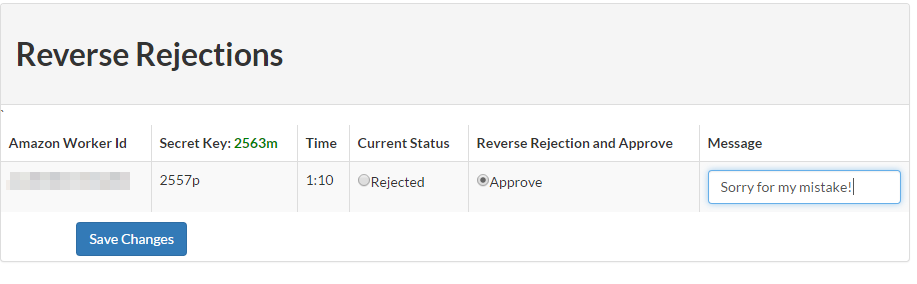
Reversing a rejection in TurkPrime is as simple as using the "Reverse Rejection" feature. Select the WorkerIds you wish to reverse, add an optional message. and you are done! No programming or installations are needed.

Maximizing HIT Participation


Problem:

How can you increase Amazon Mechanical Turk HIT Worker participation rates and speed completion of a HIT? This is particularly an issue with HITs that have a large number of required participants or have Qualifications that limit the number of qualified Workers

Solution:

By monitoring the participation rates of hundreds of HITs we have observed the following patterns that increase participation significantly:

Thursday, May 7, 2015

Exclude Workers With One Click

Problem:

Suppose you're running a Mechanical Turk survey and need to exclude workers who took a previous survey. How can you quickly set this up. 

Some of the currently used solutions require following multiple steps to set things up and are not turnkey solutions and others require Workers to enter their Worker ID, which may self-filter workers and limit the number of workers taking your survey. 

Solution:

Exclude Workers Feature 

Create your surveys using TurkPrime.com's "Exclude Workers" feature. When your HIT launches it will have a Qualification Requirement that will limit your HIT to only the Workers not in your exclude list. All excluded workers will be unqualified from taking your HIT.